
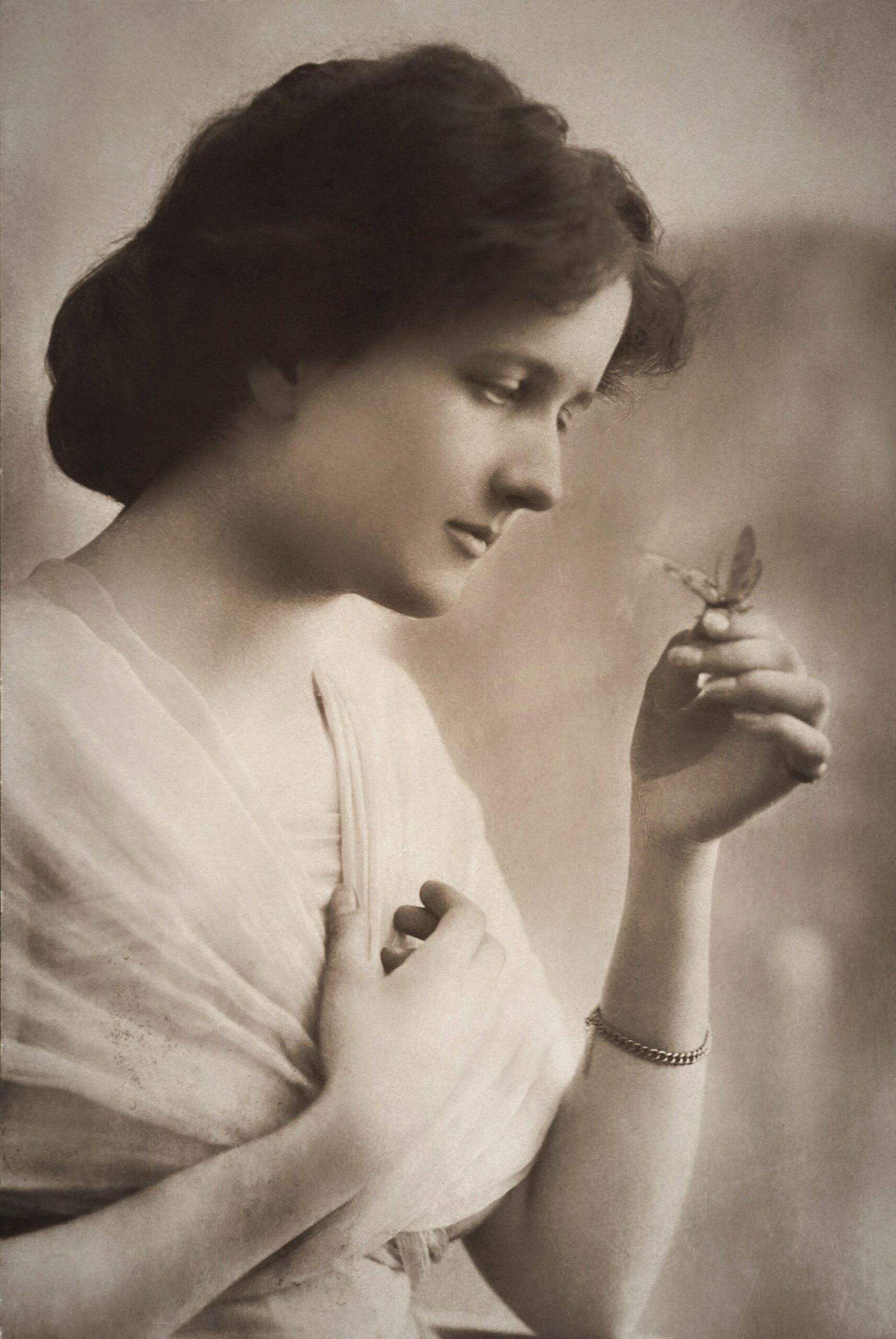
Helen Adams Keller was born to Arthur Henley Keller and Kate Adams Keller. She grew up in Tuscumbia, a small town in Alabama, where her family lived at Ivy Green, the home now closely associated with her early life.
Before her illness, Helen developed like other young children. However, in February 1882, when she was still a toddler, a serious illness left her unable to see or hear. The exact cause was never definitively established. Historical accounts have suggested illnesses such as scarlet fever or meningitis, but there is no confirmed diagnosis.
Losing both sight and hearing at such a young age created enormous communication difficulties. Helen could not understand spoken language in the usual way, and she initially had limited means of expressing her thoughts to the people around her. She developed simple gestures with family members, but these methods could not fully meet her growing need to communicate.
Her frustration sometimes appeared through difficult behavior. Without an effective way to express what she wanted, ordinary situations could become overwhelming. Her family recognized her intelligence and wanted to find a way to help her learn.
Helen’s mother eventually sought advice from people experienced in education for children with disabilities. Alexander Graham Bell, known for his work involving communication technology and deaf education, was among those who helped direct the family toward educational assistance.
This search eventually led to Anne Sullivan, a young teacher whose arrival in March 1887 became a turning point in Helen’s life.
Helen Keller should not be remembered only as a person who overcame disability. She was also a thinker with strong political opinions, a productive author, and a campaigner who questioned the barriers society placed before disabled people. Her biography is therefore both a personal story and a record of wider changes in education and civil rights.
Helen Keller and Anne Sullivan: A Life-Changing Partnership
Anne Sullivan arrived at the Keller home on March 3, 1887. She had studied at the Perkins Institution for the Blind in Massachusetts and had personal experience with serious vision difficulties. Her training and determination helped her develop an approach suited to Helen’s needs.
At first, Sullivan taught Helen by spelling words into her hand using a manual alphabet. She used this method to connect objects with their names. One early example involved spelling the word for a doll, but Helen initially repeated the hand movements without fully understanding that they represented language.
The breakthrough came on April 5, 1887, at a water pump near the family home. Sullivan placed one of Helen’s hands under flowing water while spelling W-A-T-E-R into her other hand.
Suddenly, Helen understood that the hand movements represented the substance she could feel. The experience helped her recognize that objects and experiences could be named. She then became eager to learn more words.
The water-pump lesson is widely remembered because it illustrates the moment language began to make sense to Helen. However, it was not the end of her education. It marked the beginning of a long learning process that included reading, writing, communication, and formal study.
Sullivan continued teaching Helen through tactile spelling, raised print, and other educational methods. Helen learned to read and write and later studied spoken language. Although she worked hard to improve her speech, it remained difficult for many listeners to understand.
Their relationship developed into a lifelong partnership. Sullivan became Helen’s teacher, companion, and trusted guide, helping her navigate educational institutions and public life. Helen, in turn, became an increasingly independent writer and thinker.
Their story inspired William Gibson’s play The Miracle Worker, which was later adapted for film. These productions introduced their relationship to generations of audiences, although Helen’s full life and political work extended far beyond the events commonly portrayed on stage and screen.
The partnership between Helen Keller and Anne Sullivan remains a major example of the importance of individualized education, patience, and communication tailored to a learner’s needs.
Helen Keller’s Education and College Achievements
Helen Keller’s education demonstrates how specialized teaching and determination can open doors that society may initially consider inaccessible.
After learning to communicate, she continued her studies at institutions that supported blind and deaf students. She attended the Perkins Institution for the Blind and later studied at the Wright-Humason School for the Deaf. These experiences helped her develop the skills needed for more advanced academic work.
Helen was determined to attend college. To prepare, she studied at the Cambridge School for Young Ladies in Massachusetts. College preparation required considerable effort because much of the educational material had to be made accessible through alternative formats and communication methods.
In September 1900, Helen entered Radcliffe College, the women’s college associated with Harvard University at the time. Anne Sullivan accompanied her and helped communicate lectures and academic material through tactile spelling.
Helen completed her degree in 1904, graduating cum laude with a Bachelor of Arts. She is widely recognized as the first deafblind person to earn a Bachelor of Arts degree.
This achievement was significant not only because of the academic work involved but also because educational institutions were rarely designed with deafblind students in mind. Helen had to study subjects, complete assignments, and demonstrate her knowledge despite substantial barriers to accessing conventional classroom instruction.
Her college experience also showed that disability did not prevent intellectual achievement. It highlighted the importance of accessible educational materials, skilled support, and opportunities for students to demonstrate their abilities.
Helen’s academic success influenced how the public viewed disabled students. Rather than accepting the idea that people with significant sensory disabilities could not pursue higher education, her life provided a powerful counterexample.
Today, her educational journey remains relevant to discussions about inclusive classrooms, assistive technology, accessible books, and equal access to higher education. Her achievement was personal, but its wider significance lies in the opportunities it helped people imagine for future generations.
Helen Keller as an Author and Public Speaker
Although Helen Keller is frequently introduced through her childhood, writing became one of the most important parts of her adult life. She published books, essays, letters, and speeches covering subjects that ranged from personal experience and philosophy to politics and social reform.
Her best-known book, The Story of My Life, was first published in 1903. It describes her early life, her education, and her relationship with Anne Sullivan. The autobiography became widely read and has been translated into numerous languages, helping readers understand how Helen developed communication skills and pursued her education.
The book also gives insight into her intellectual life. Helen did not simply recount childhood experiences. She reflected on learning, memory, literature, nature, friendship, and the importance of communication.
Another important work was The World I Live In, published in 1908. In this book, Helen discussed her experiences and perceptions, offering readers a perspective on how she understood the world through touch, smell, movement, and other forms of sensory information.
Her writing challenged the assumption that people who cannot see or hear lack rich intellectual or emotional lives. She demonstrated that human experience cannot be reduced to the presence or absence of a single sense.
Helen also wrote about social and political issues. Her published work addressed workers’ rights, women’s suffrage, war, poverty, and other concerns. She developed positions that sometimes attracted criticism, particularly when her political views challenged mainstream opinion.
Public speaking and international travel further expanded her influence. She communicated with audiences through prepared speeches, interpreters, and support from her companions. Her work reached people who might never have read her books.
Helen’s literary legacy is preserved in the Helen Keller Archive maintained by the American Foundation for the Blind. The collection contains correspondence, manuscripts, speeches, photographs, and other historical materials that allow researchers to study her work in greater detail.
Her writing remains important because it offers more than an inspirational story. It records the ideas of a woman who used her education and public platform to participate in major debates of her time.
Helen Keller’s Disability Rights and Social Activism
Helen Keller’s influence extended well beyond education and literature. She became a prominent advocate for people with disabilities and worked to improve access to education, rehabilitation, employment, and public services.
In 1924, she began working with the American Foundation for the Blind. She remained associated with the organization for more than four decades, using her public profile to draw attention to the needs of people with vision loss.
Her advocacy involved communicating with government officials, addressing public audiences, raising awareness, and supporting initiatives intended to improve the lives of blind people. She traveled extensively and met individuals and organizations working on disability-related issues.
Helen understood that individual determination could not solve every barrier. People with disabilities also needed accessible education, suitable employment opportunities, rehabilitation services, and public policies that recognized their rights.
She supported efforts to improve access to books and information for blind readers. Her work helped draw attention to the importance of braille, accessible reading materials, and services that enabled people with vision loss to participate more fully in society.
Her activism also extended to women’s rights and economic justice. Helen supported women’s suffrage and became involved with socialist politics. She criticized social and economic inequalities and advocated for workers whose conditions she considered unfair.
She was a pacifist and opposed war, although her political positions sometimes placed her at odds with popular opinion. These commitments show that she was not simply a symbolic figure admired for personal courage. She was a politically engaged individual who developed strong views about how society should change.
During World War II, Helen visited military hospitals and met wounded soldiers, including those with serious disabilities. These visits reflected her longstanding interest in rehabilitation and in helping people rebuild their lives after injury.
In 1946, she began a series of international journeys supporting services for people with vision loss. Over the following years, she visited countries across several continents, meeting communities and drawing attention to the need for better educational and rehabilitation opportunities.
Helen Keller’s activism helped make disability a public issue rather than something that should remain hidden within families or institutions. Her work continues to inform discussions about accessibility, independence, inclusion, and equal rights.
Helen Keller’s Later Years, Death, and Lasting Legacy
Helen Keller continued her advocacy and public work well into later life. She traveled internationally, maintained relationships with political and cultural figures, and remained committed to improving opportunities for people with disabilities.
Her journeys helped bring international attention to blindness prevention, rehabilitation, accessible education, and support for people who were deafblind. The scale of her work demonstrated that disability advocacy was not limited to one country or one institution.
In 1955, a documentary about her life, originally titled The Unconquered and later released as Helen Keller in Her Story, received the Academy Award for Best Documentary Feature. The film introduced audiences to her life and work beyond the familiar childhood narrative.
In 1964, President Lyndon B. Johnson awarded Helen Keller the Presidential Medal of Freedom, one of the highest civilian honors in the United States. The recognition reflected the significance of her contributions to public life.
Helen experienced a stroke in 1961 and gradually withdrew from public appearances. She spent her later years at her home, Arcan Ridge, in Westport, Connecticut.
She died on June 1, 1968, at the age of 87. Her ashes were placed at Washington National Cathedral in Washington, D.C., alongside those of Anne Sullivan Macy and Polly Thomson, who had supported her later in life.
Helen Keller’s legacy continues through her published works, preserved archives, educational programs, disability advocacy, and the organizations connected with her work. The American Foundation for the Blind maintains extensive historical resources that help new generations explore her writings and accomplishments.
Her story is still taught in schools because it connects personal achievement with broader questions about education, disability, and equal opportunity. Yet her legacy is most meaningful when it includes her own words, ideas, and activism rather than reducing her life to a simple message about overcoming adversity.
Helen Keller showed that people with disabilities can contribute to literature, public debate, education, and political change. She also helped demonstrate that society has a responsibility to remove barriers and create opportunities for everyone.
Frequently Asked Questions About Helen Keller
Who was Helen Keller?
Helen Keller was an American author, educator, and social activist who became deaf and blind as a toddler. She gained international recognition for her education, writing, and advocacy for people with disabilities.
When was Helen Keller born?
Helen Keller was born on June 27, 1880, in Tuscumbia, Alabama, United States.
How did Helen Keller become deaf and blind?
She lost her hearing and sight after a serious illness at approximately 19 months of age. The exact illness was never definitively identified.
Who taught Helen Keller to communicate?
Anne Sullivan became Helen’s teacher in March 1887. She taught Helen through a manual alphabet spelled into her hand and helped her develop reading, writing, and communication skills.
What was Helen Keller’s most famous book?
Her best-known work is The Story of My Life, published in 1903. It describes her early experiences, education, and relationship with Anne Sullivan.
Did Helen Keller attend college?
Yes. She attended Radcliffe College and graduated cum laude in 1904 with a Bachelor of Arts degree. She is recognized as the first deafblind person to earn such a degree.
What did Helen Keller do for disability rights?
She advocated for accessible education, rehabilitation, employment, and better services for people with vision loss. She worked with the American Foundation for the Blind for more than 40 years.
When did Helen Keller die?
Helen Keller died on June 1, 1968, at the age of 87, in Westport, Connecticut.
Conclusion
Helen Keller’s life remains an important chapter in the history of education, literature, and disability rights. From her early communication difficulties to her graduation from Radcliffe College, she demonstrated what could become possible when determination was supported by effective teaching and meaningful opportunities.
Her relationship with Anne Sullivan helped unlock the world of language, but Helen’s later achievements reflected her own intellectual curiosity, writing ability, and commitment to social change. Through her books, speeches, travels, and activism, she encouraged people to reconsider the abilities and rights of those living with disabilities.
Remembering Helen Keller means recognizing both her personal accomplishments and the barriers she worked to change. Her story continues to encourage educators, families, researchers, and disability advocates to build a society in which access to learning, communication, and public life is available to everyone.